

When Should You Get That Pain Checked? A Sports Medicine Doctor Explains
Guest: Dr. TJ Ridley, Orthopedic Sports Medicine Surgeon
Host: Pete Waggoner
Episode Length: 19 minutes, 16 seconds
Your knee hurts after a game of pickleball. Your shoulder aches after golfing. Or maybe your hip has been bothering you for weeks, and you’re starting to wonder if it’s more than normal soreness.
Should you rest and wait? Keep exercising? Or make an appointment?
Listen on your favorite platform:
Or listen to this episode below.
In this episode of Beyond the Checkup, host Pete Waggoner welcomes Dr. TJ Ridley, an orthopedic sports medicine surgeon joining Stellis Health, to answer questions many people have about joint pain, injuries, and getting the right care.
And here’s something you might not know: You don’t have to be an athlete to see a sports medicine doctor.
Normal Soreness or Something More?
We’ve all felt sore after a workout, a busy weekend, or trying something new. But how do you know when that soreness could be a sign of an injury?
Dr. Ridley explains that normal soreness is often spread across a larger area rather than one specific spot. It may feel better as you warm up or stretch, and it generally improves over the next week or two.
Pain that is sharp, easy to pinpoint, or getting worse instead of better may need more attention.
He also encourages people to listen to their bodies.
“You know your body best.”
If something doesn’t feel right, that feeling is worth paying attention to.
When Should You Get Joint Pain Checked?
Not every ache requires a specialist visit. But Dr. Ridley says it’s important to notice whether your symptoms are improving.
For many minor injuries, he uses a general one- to two-week window to see whether things are getting better.
Other questions to consider include:
- Is the pain getting worse instead of better?
- Is it affecting your sleep?
- Are you changing how you walk, play, or exercise?
- Are you avoiding activities you normally enjoy?
- Does the joint feel unstable or seem to shift?
- Did you feel a pop or notice swelling after an injury?
A sudden injury with a pop, swelling, or instability deserves particular attention. These symptoms should not be treated as something to simply play through.
The key message is that you don’t need to wait until pain takes over your daily life to ask for help.
Sports Medicine Isn’t Just for Athletes
The words sports medicine may bring to mind professional athletes, college sports, or high school injuries.
But Dr. Ridley sees a much wider range of patients.
His patients include weekend warriors, pickleball players, older adults, and people who simply want to stay active and comfortable.
Sports medicine focuses on helping people return to the activities that matter to them.
For one person, that may mean getting back on the hockey rink. For another, it could mean playing with grandchildren, walking comfortably, or returning to a favorite hobby.
You don’t need to play a competitive sport to benefit from a sports medicine evaluation.
Does Seeing an Orthopedic Surgeon Mean You Need Surgery?
This is one of the biggest concerns patients have.
Dr. Ridley explains that seeing an orthopedic surgeon does not automatically mean surgery.
In fact, he shares that only about 20% of patients in his own practice end up having surgery.
That figure describes his personal practice experience, not a guarantee about what any individual patient will need.
Many patients can be treated without surgery.
Depending on the condition and the patient’s needs, options may include changing activities, physical therapy, medications, or injections.
Dr. Ridley is a strong supporter of physical therapy and often starts with more conservative options before considering additional treatments.
The goal isn’t to rush toward surgery. It’s to understand the problem and find an appropriate way forward.
Do You Need an X-Ray or MRI?
If your knee, hip, or shoulder hurts, you may wonder whether you need imaging.
Dr. Ridley explains that X-rays and MRIs provide different information.
X-rays help doctors look at bones and joint structures.
MRIs provide a more detailed view of soft tissues that may not show up clearly on an X-ray.
During an orthopedic visit, Dr. Ridley typically starts by learning about the patient’s symptoms, reviewing appropriate imaging, and performing a physical exam.
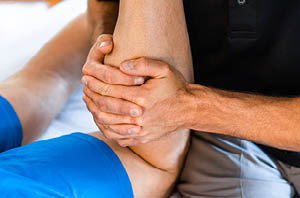
He wants to understand when the pain started, what makes it better or worse, and how the joint moves.
From there, he and the patient discuss whether more testing is needed or whether treatment can begin.
Can You Keep Exercising Through Pain?
This is a tough question for anyone who enjoys staying active.
Dr. Ridley’s answer depends on the injury and whether continuing the activity could cause more damage.
Some discomfort may not mean you need to stop every activity. But an unstable joint or certain damaged tissues can become worse if you continue pushing through.
He discusses examples such as a knee that shifts because of an ACL injury or a shoulder that repeatedly dislocates.
That’s why knowing what is causing the pain matters.
Rather than guessing whether it’s safe to keep playing, an evaluation can help you understand your options.
Is Joint Pain Just Part of Getting Older?
It’s easy to blame knee, hip, or shoulder pain on age.
Dr. Ridley acknowledges that conditions such as arthritis and tendon problems become more common as people get older.
But age alone doesn’t tell the whole story.
He looks at how long symptoms have lasted, how severe they are, and whether they affect daily activities.
If pain is keeping you from doing the things you enjoy, it’s worth discussing with a healthcare professional.
Getting to Know Dr. TJ Ridley
Dr. Ridley’s interest in orthopedics began while playing sports and experiencing injuries himself.
He was drawn to the combination of sports, anatomy, movement, and helping people return to activities they enjoy.
He also enjoys the problem-solving side of sports medicine. Different patients may have different goals, even when they have similar injuries.
Throughout the conversation, he emphasizes the importance of working with patients to understand what matters most to them.
As he joins Stellis Health, Dr. Ridley says he’s especially excited about the people, the community, and building relationships with other healthcare professionals who support patients.
He believes good care often involves a team, including primary care providers, physical therapists, and other specialists.
The Takeaway: Listen to Your Body
You don’t have to be a competitive athlete to seek sports medicine care. And you don’t have to assume that joint pain means surgery.
Whether you’re dealing with a recent injury or discomfort that has been building for months, understanding what’s causing the problem is an important first step.
The goal is to help you keep doing the things you love.
Listen to Beyond the Checkup
Hear the full conversation with Dr. TJ Ridley as he explains when to get joint pain checked, what sports medicine doctors do, and how patients can better understand their treatment options.
Ready to explore care options? Visit Stellis Health’s Get Care page.
Share this episode: Know someone who’s been putting off getting their knee, hip, or shoulder checked? Share this conversation with them. It may help answer a question they’ve been wondering about.
This podcast and blog are for educational purposes and are not a substitute for personalized medical advice. Sudden severe symptoms or a serious injury may require prompt medical evaluation.
Transcripts
Transcript Disclaimer
This transcript has been edited for readability while preserving the intent and accuracy of the conversation. Minor changes have been made to correct grammar, punctuation, speaker identification, and transcription errors. This podcast is intended for educational purposes only and should not be considered medical advice. Always consult your healthcare provider regarding questions about your health or medical condition.
Beyond the Checkup | Stellis Health
Host: Pete Waggoner | Guest: Dr. TJ Ridley, Orthopedic Sports Medicine Surgeon | Runtime: 19:16
[00:00:00] Pete Waggoner, Host
Hi there, and welcome to Beyond the Checkup, brought to you by Stellis Health, where neighbors care for neighbors. I’m your host, Pete Waggoner. Knee hurting after pickleball? Shoulder bothering you on the golf course? How do you know when it’s time to get that pain checked?
Today, we’re joined by orthopedic sports medicine surgeon, Dr. TJ Ridley, to talk about everyday aches, injuries, and when it’s time to seek care.
And here’s something you might not know. You don’t have to be an athlete to see a sports medicine doctor. Let’s get started.
TJ, how are you?
[00:00:26] TJ Ridley
Good.
[00:00:27] Pete Waggoner, Host
We, go back a ways. That’s right. I think you were what, maybe 14-
[00:00:30] TJ Ridley
Sounds
[00:00:30] Pete Waggoner, Host
about right … years old. Yeah.
[00:00:31] TJ Ridley
Yep.
[00:00:31] Pete Waggoner, Host
You were playing hockey in Edina. Do I say that?
I kinda stumbled there because it’s that good or bad
[00:00:37] TJ Ridley
Yeah. I’m
[00:00:37] Pete Waggoner, Host
proud of it. But I, yeah, own it. Absolutely. And it was an absolute tremendous experience for me as a coach because every team that you have has a different set of characters, and you have to communicate with every player differently.
And you always had a trademark ease about your personality for the entire room and a general leadership capabilities. And I am not in one bit least surprised that you are in this role with what you do for work and this career. So I can’t say enough about you as a leader, as a friend to the players, as a person I run into every once in a while.
Just an absolute positive, quality energy. And I think everybody at Stellis Health and in this area are very fortunate to have you join. So I’m really excited to do this with our history. It’s super fun. It’s like wearing a glove, buddy.
[00:01:26] TJ Ridley
Well, thank you.
[00:01:26] Pete Waggoner, Host
You bet. So let’s get into it right now. We have plenty of questions, but you and I chatted before this started.
There’s sports medicine in what you do, and then there’s not. Like, what’s the difference between the classifications?
[00:01:38] TJ Ridley
So if you think about orthopedics just kinda from a high level, stepping back, it’s broken up into some different subspecialties, call it. You’ve got hand surgeons, foot and ankle, spine, trauma, joint replacement pediatrics, and then you’ve got sports medicine.
And sports medicine, while it has the title sports, it’s certainly not all sports injuries, but a lot of it come from that. And really, it’s a mindset that it’s about restoring the joint, restoring the person back to activities, back to their functional level, things that they wanna get back to.
[00:02:09] Pete Waggoner, Host
Got it.
Okay. So, when you get into getting people restored back- Maybe you’re a little sore, but you’re not sure if that’s into the joint area or there’s something more going on. How can someone tell the difference between that, and what do you do with that?
[00:02:22] TJ Ridley
Yeah, so I mean, general soreness, achiness, you know, after an injury, a tweak, and you probably get your peak symptoms about 48 hours after that injury when it’s kind of the general soreness.
It is that. It’s sort of a general soreness. You can’t maybe pinpoint one area. It’s kind of the whole area. And generally, then it gets better over the first week or two. It gets better as you maybe warm up and you kind of stretch and those kinds of things. An injury to be more concerned about is something that is maybe a little bit more sharp.
You can pinpoint it. It’s getting worse, not better, over that first week or two. Certainly, there’s those injuries where you get that pop. You get that dramatic sort of injury and the dramatic symptoms following, but most injuries are kind of these that just build up a little bit over time.
[00:03:03] Pete Waggoner, Host
So it’s rare when you’re dealing with people where it’s like a moment where you blew something out- Right
that we see on the field- Right … let’s say.
[00:03:10] TJ Ridley
Right.
[00:03:11] Pete Waggoner, Host
This is more of an over time thing. You were an athlete at a high level, racing up and down the ice at Braemar Arena. Did you ever have any injuries and symptoms of such-
[00:03:19] TJ Ridley
Yeah … with
[00:03:19] Pete Waggoner, Host
that?
[00:03:20] TJ Ridley
Quite a few. All right. You know, you get the bumps and the bruises, of course, and again, it’s like you wake up the next day, maybe you’re a little sore, and then you wake up the next day, and now you’re really sore, but then you kind of work through it throughout the week.
And then those injuries where you know something’s going on, and you go see the trainer pretty quickly. You feel a pop. You feel a shift. Something just doesn’t quite feel right. I often tell people, ” You know your body best.” A lot of people can tell you something’s not right, and it’s important to listen to that.
[00:03:45] Pete Waggoner, Host
When do you draw the line where, , this is a nagging situation that you can overcome, and then it becomes a little more serious? You know, are there signs or symptoms? Is there swelling? Is there throbbing? What type of things are things you can differentiate from if you’re experiencing these things?
[00:04:00] TJ Ridley
After maybe an acute injury, my general rule of thumb is give it a week or two. Is it getting better, or is it staying the same or getting worse? Are you having to modify things? Is it affecting your sleep? Are you not inclined to do that extra game of pickleball, or you’re having to swing the racket differently because it’s bothering you?
Are you having to change things? Those are when you start to get a, maybe a little bit worried that it’s becoming something more than just a minor injury.
[00:04:24] Pete Waggoner, Host
I would assume it’s fair to say it’s never a harm to have it checked to know you’re okay.
[00:04:29] TJ Ridley
Right. If it’s something that’s bothering you for a week or two, and whether it’s bothering you or just mentally you’re just worried about it is good to get it checked.
Because a lot of these things, the sooner you get it checked, the sooner you get it diagnosed, the sooner you can start treating it. The longer duration of some of these symptoms, the longer time then it takes to recover from on the back end when you start to actually treat it. So a lot of this getting seen, getting treated, or at least diagnosed early on really can help.
[00:04:53] Pete Waggoner, Host
So now that we’re establishing, like, when you should do something and figuring it out- I’ve always thought of this too, and I’ve never really thought about it, sports medicine doctor. You think that’s reserved to the kids that get banged up on the field or the athletes at the higher levels, and it’s just sports people.
Is that true or not true? Can you treat anybody, I assume.
[00:05:11] TJ Ridley
Certainly we get the high school, college, every once in a while some professional athletes. But really most of what we see is the weekend warriors, the pickleballers, the, even the grandma, grandpa, they’re getting an ache picking up their kid off the floor when they’re watching the grandkids.
So what’s kinda fun about sports medicine is you get this broad spectrum of patients.
[00:05:29] Pete Waggoner, Host
So when you help someone like that, do you find they come back to you and say, ” You know what? My pickleball game, my golf game, I’m back on the rink,” whatever it is. “I’m playing basketball again.” Do they come back and say, “I should’ve done that sooner”?
[00:05:40] TJ Ridley
A lot of times, yes.
[00:05:42] Pete Waggoner, Host
Yeah.
[00:05:42] TJ Ridley
A lot of times people are worried that, well, if I go see a surgeon, they’re just gonna tell me I need surgery, or they’re gonna get maybe rushed into something. But the truth is, only about 20% of patients that I see, at least in my practice, end up getting a surgery.
And so most of the time, we can manage these aches and these pains and these whatever it is with the non-surgical treatments. And so a lot of times they, yeah, wish they would’ve come in sooner. If it ends up being a surgery, sometimes they still say, “Yeah, should’ve done it sooner.” So it’s, I’d say never too early to get seen if something’s bothering you.
[00:06:12] Pete Waggoner, Host
What would a non-surgical treatment look like? Is that therapeutic prescriptions, medications? What do you typically do in those scenarios?
[00:06:19] TJ Ridley
Yeah, all the above. You try to go through a stepwise approach, the more conservative things to the less conservative things. So simple things, modify your activities.
It’s that old adage, if it hurts, don’t do it. So you know, if something’s bothering you, maybe modify or change it, at least temporarily. The ice, the heat, the anti-inflammatories. I’m a big proponent of physical therapy that can be dramatically effective for people. And if those things are working, then you step it up.
If an injection is indicated, that can be helpful for people. Maybe more prescription-based anti-inflammatory medications, other things like that. There’s a lot of then maybe call it less mainstream approaches, such as shockwave therapy and laser therapy and acupuncture. All these things they have a place.
There’s maybe less evidence to support some of these than others, but people do really well with them. I have done really well with some of those treatments myself, and so I’m a believer that whatever we need to do to get you feeling better is reasonable.
[00:07:14] Pete Waggoner, Host
So it sounds to me like you’re pretty open new ways to look at things.
You’re not locked in on one set way. And as you’ve observed that How impressed are you with how one thing leads to the next, which where this has kinda grown along the way from what you even started with?
[00:07:30] TJ Ridley
That’s what’s fun about medicine, but particularly sports medicine in general. Mm-hmm.
There’s a lot of, outside the box thinking. We are, as providers, we are really driven by our patients wanting to get back faster, with less pain, with less aggressive intervention. So we’re often challenged from a, medical community to find ways to get people back to those activities faster, more reliably, with less pain, with less aggressive intervention.
And so it’s a fun field in that it advances very rapidly, and it’s always changing.
[00:08:00] Pete Waggoner, Host
Well, that’s wonderful. So you can’t… if you fear change, it’s probably not the best field, right? Yeah. This is interesting. Joint pain, that can really know any age, correct? And at what point does it say, you know, it’s just I’m getting older thing?
Where do people need to start ignoring their age with joint pain, and where does that fit?
[00:08:16] TJ Ridley
Yeah, age is a tricky one. Oftentimes age really is just a number. Now certain things happen more frequently as we age, like things like arthritis or tendonitis, maybe some of those things. But it’s important to treat the symptoms, the duration of the symptoms, the severity.
Is it affecting your daily life? Is it just affecting certain things? And once it starts affecting your daily life, your daily routines, those activities you really like to do, that’s when it’s time to stop ignoring it.
[00:08:42] Pete Waggoner, Host
It the thing that you said earlier that really stands out to me is if it’s affecting your sleep, too.
[00:08:47] TJ Ridley
Yeah.
[00:08:48] Pete Waggoner, Host
I think that’s a big one, huge tell for everybody to get involved with. Okay, then when you come in for a knee, hip, shoulder pain how do you handle that? X-rays, MRIs, all of the above? What do you do there?
[00:08:57] TJ Ridley
Yeah, generally in my practice I do like to get an X-ray early on.
It helps me just get a lay of the land, a 10,000-foot view of what’s going on with the joint or the area of the body that we’re looking at. X-rays these days are, they’re cheap, they’re easy to get, and, the radiation concern is very minimal. Nowadays, they’re low-dose radiation. Really, we don’t worry much about that from at least, a single or a couple of X-rays before you come in and see us.
So the general workflow is you get in, my assistant or somebody with the intake will kinda take in your symptoms and get a lay of the land there. Generally, we’ll get an X-ray, and then I’ll come in and see you, and then we’ll start to piece it together. I like to understand, what’s the story?
How long has this been going on for? When did it start? How did it start? What’s making it worse? What makes it better? We’ll go over the X-rays. We’ll do a physical exam, so I’ll assess whatever body part it is and see how it moves. What causes pain? What doesn’t cause pain? Is the joint stable?
Is it loose? Is it tight? And then as we start to formulate maybe a diagnosis, I say we ’cause this is very much a back and forth with the patient. As we develop that diagnosis, then we start to think, “Okay, do we need more information here, like an MRI? Do we need some other tests, lab tests, those kinds of things?”
Or have things more or less checked out and we just maybe need to start with some conservative things? And again, I say we, it’s a conversation, it’s an open discussion of what kind of… what makes sense for both of us as a team to get you as the patient better.
[00:10:21] Pete Waggoner, Host
I’ve never asked this. I’m going to because I wanna know and I feel like I can ask you.
What is the real difference between an X-ray and an MRI?
[00:10:28] TJ Ridley
Yeah. So X-ray is, it’s basically, not to get too techy with it, but high level. X-ray really helps you see the bones. You can see some of the soft tissues, but it’s radiation, again, low-dose radiation, to see the bones and the bony structures.
MRI more or less is helping you look at those soft tissues that the X-ray couldn’t quite see, and in a more sort of three-dimensional way of looking than at those soft tissues.
[00:10:53] Pete Waggoner, Host
So when you look at an MRI, then if you’re gonna have surgery and you go in, do you have, a really good overview of where you’re going, or is sometimes it’s exploratory?
[00:11:02] TJ Ridley
A little bit of both. The technology has advanced so much- Mm-hmm … these days that the MRI quality is really very good. There are certain things that still maybe don’t get picked up well on MRI. Cartilage is one of them. There are some newer sequences or filters I like to call them that are maybe better at picking up cartilage, but that’s often one that can be hard to assess the, maybe those smaller little cartilage injuries.
And so sometimes, most of the time, the MRI gives us a good idea. Sometimes you’re kinda going in to say, “All right. Let’s see what we find.” You hope you’re not getting to that situation, but sometimes you’re kinda stuck with, “Well, nothing else has given us the information we’re looking for. Sometimes we need to go kinda take a look.”
[00:11:41] Pete Waggoner, Host
Okay. We’re gonna shift gears a little bit. I think you probably grew up in an era where it was like you take the hit, and you’re a gamer if you do that. And you jam your shoulder, and you play through the pain, and you keep going. The question here is, do you get a lot of people that say, “Can I play through this pain of walking or playing a sport,” whatever it is, and where do you draw the line of saying, “That’s probably not a good idea”?
[00:12:05] TJ Ridley
Yeah. I always like to give the classic doctor example. “Well, it depends.”
[00:12:08] Pete Waggoner, Host
Thanks for that.
[00:12:09] TJ Ridley
Yes, yes. So high level you can play through the pain if it’s not gonna cause more damage. Okay, well, that obviously leads to the next question, how do you know if it’s gonna cause more damage?
Right. Generally, if the joint is unstable, you’re gonna cause more damage if it continues to be unstable. Think about a shoulder that’s dislocating in and out. Think about a knee without an ACL that’s shifting because it’s unstable. Those kinds of things you are going to cause more damage. If you’ve torn or damaged tissue that can be protective, like a meniscus, it’s the cushion in your knee, if that’s torn, you could make that tear worse.
You could make the structures that it’s supposed to protect worse if you try to fight through it. And so that’s where, the obvious case, you get a pop, the joint swells, you feel it’s unstable, it pops out and pops back in, all of those things- Pretty obviously you should get that checked out. Where it gets tough is, yeah, if it’s just this soreness you take a hit into the boards and my shoulder kind of feels okay.
It’s kind of hard to raise it, but it didn’t pop in or out. I think I can take some Advil and fight through it. Yeah, those become the questionable ones, but I think that’s where it’s important to have good athletic trainers at the schools. Or if you get hurt at the club, go see the physio or go see the trainer, somebody who’s maybe got some medical background to give you a once-over.
If it then bothers you for more than a week or two, now come in and see the specialist.
[00:13:28] Pete Waggoner, Host
Yeah, if it’s persisting.
[00:13:29] TJ Ridley
Right.
[00:13:29] Pete Waggoner, Host
But obviously you always hear, “Listen to your body.” And you said earlier, nobody knows your body better than you. Right. Listen to it and tell me.
[00:13:36] TJ Ridley
Right.
[00:13:36] Pete Waggoner, Host
Do you ever run into situations where maybe people don’t share the full story sometimes?
[00:13:42] TJ Ridley
Yeah, it can be a little of all that. Sometimes they don’t know. They can’t remember when it initially happened. Sometimes they’re embarrassed, right?
[00:13:50] Pete Waggoner, Host
Right. Yeah.
[00:13:50] TJ Ridley
Right? They, had a dumb trip in the parking lot that should have never happened, or they were looking at their phone so they tripped on the curb, but they just kinda don’t wanna tell you that.
Yeah. And it’s like, you know, it’s no judgment here. Like, it is good to know kinda what happened and how it happened, ’cause if you weren’t looking at your phone, you lost balance ’cause you got lightheaded, well, we should look into that. So, it’s important to be forthcoming, and I get why you can be embarrassed, especially with some of these injuries that are, you know, these dumb injuries.
“Oh, it was a bad decision. It happened so fast. I shouldn’t have been doing XYZ.” It’s like we’ve all been there.
[00:14:19] Pete Waggoner, Host
Yeah. Yeah, it’s, it’s human.
[00:14:20] TJ Ridley
Yeah.
[00:14:20] Pete Waggoner, Host
Right? Yeah. It’s, it’s just how it works. What did draw you to sports medicine? Obviously medicine was something you wanted to be a part of, but why this?
[00:14:29] TJ Ridley
Yeah.
I kinda have the classic orthopedic surgeon story where I played sports growing up. I had my own orthopedic injuries, got to know, kinda this cool, suave ortho doc, Dr. Schaffhausen, if you remember him.
[00:14:42] Pete Waggoner, Host
Yeah. Yeah.
[00:14:42] TJ Ridley
And it’s just you’re involved in that world so much of your life growing up with the sports and the training room, and I was always, intrigued by, that profession and the anatomy of things and just how things works in the biomechanics and all of those kinds of things.
So it was just this perfect blend of, Yeah, it’s sports, but again, as we talked about, it’s not all sports-related things. Active lifestyles, people driven to wanna stay active, stay healthy, do the things that they wanna do. And it’s a cool field in that things are always advancing. You have to think outside of the box.
You have to really understand what the patient wants, because in sports medicine, there are oftentimes a lot of different options. And so it’s important to know what the patient wants, what their expectations are, educate them on what the different options are, and then choose it sorta collectively together.
Whereas in… This is broadly speaking, but someone has arthritis, well, let’s just replace it. Sports medicine’s a little bit more nuanced and creative, and things are always changing. And so it just makes the job and the specialty that much more interesting, that much more challenging, but that much more interesting.
[00:15:48] Pete Waggoner, Host
In your career, have you had a skewed demographic age-wise? Or has it been all over the map?
[00:15:54] TJ Ridley
It really has been all over the map.
[00:15:55] Pete Waggoner, Host
Really?
[00:15:56] TJ Ridley
It, it really has. I still see a fair amount of, pediatric injuries and fractures. I still do joint replacement as well, so I see the whole spectrum.
And what I like about that is I can kinda help give some guidance on both sides of the coin. Do we reconstruct, do we preserve, do we, replace? And so with that, you get to see a whole spectrum of people and problems and problem-solving, and it’s fun ’cause you get to know people on such a different level in all walks of their life with different expectations.
Not everybody’s a athlete trying to get back to the next season. That’s not what the 65-year-old grandmother who just wants to pick up her kid wants. So you have to sort of treat the person who’s in front of you and not just the problem that’s in front of you, if that makes sense.
[00:16:37] Pete Waggoner, Host
Obviously you’re starting here at Stellis, and it’s in a couple weeks from when we’re recording this podcast.
Mm-hmm. What drew you to here?
[00:16:43] TJ Ridley
I really think it’s the people, it’s the culture, it’s just kinda the mindset of how they do things, certainly from a patient side of things, but from a, backend business side of things as well. It’s really, it’s a people first organization and culture.
They do such a good job, being a part of the community, treating the community. Neighbors caring for neighbors really is what they… they practice what they preach. And so I really liked that sort of change in mindset and culture. And it can be hard to find these days as more, places and practices and groups are kinda getting, you know, kind of all built up.
You know, there’s still… Even though there’s, some of that always ongoing, there is just this feel of small town, good people, good-hearted people that just wanna treat people in the community and do the right thing.
[00:17:27] Pete Waggoner, Host
Well, I’m gonna support that by saying there’s no better fit for here than yourself, because you’re approachable, you’re engaging, you’re a likable person, you’re in everything for the right reasons.
And there is no doubt your phone will be ringing with the community here at Stellis Health. The fit couldn’t be better for this organization for me, because I talk to everybody, and that’s the beautiful part about this organization, i’m so excited that you’re doing this. What are you looking most forward to as far as just engaging into the community and just settling in? How are you gonna approach that?
[00:17:58] TJ Ridley
What I’m most excited about is just getting to know all of the other providers in the area.
Certainly at Stellis Health, but the physical therapists, the chiropractors, the functional medicine providers. I really enjoy getting to know who’s, who else is out in the community because although I… it’s torn, let’s fix it, there’s so much more to that. You need a good community around a patient to help them get better, whether that’s dietician, primary care provider, their physical therapist.
You really need a good team around you, and that’s one thing I’m really excited about what we’ve been building here as I’m getting ready to start, is we’ve got a great PA joining us. We’ve got existing personnel here that have a lot of experience. We’re really building this well-rounded team around me and the department that I’m really excited about.
[00:18:43] Pete Waggoner, Host
I’ve never done this on the air, but I’m gonna shake your hand. TJ Ridley, I am so incredibly proud of who you’ve become and what you do. It’s amazing. So, I get a little emotional. You see these kids, they’re like your kids. Even though you only have them for one year or two or whatever it is, and to see them like this, it’s incredible.
And that’s a wrap for today’s episode of Beyond the Checkup, brought to you by Stellis Health, where neighbors care for neighbors. If this conversation helped answer a question you’ve had, share it with a friend or a family member who might benefit from hearing it, too.
To learn more or schedule care, visit Stellis Health Get Care page. Thanks for listening, and we’ll see you next time.